The Thinking behind Guerrilla Change
Guerrilla Change isn’t just about funny stories, cardboard boxes and daring to do things differently.
Behind the stories are also insights from research into employee engagement, human behaviour and organisational complexity.
A handful of studies and thinkers have helped me better understand why change so often gets stuck — and why small, smart interventions can sometimes have a surprisingly big impact.

Gallup - Employee Engagement
Only 20% of employees worldwide are truly engaged.
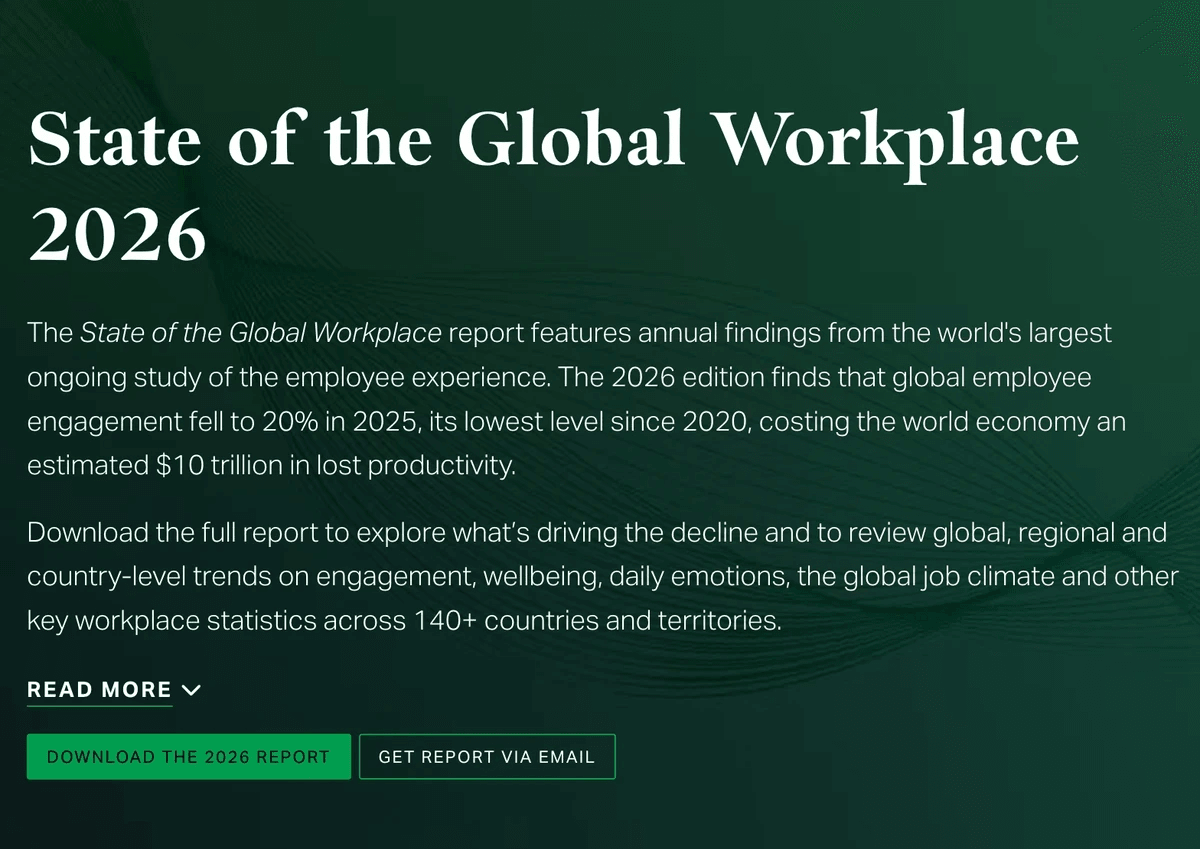
Gallup has been studying employee engagement around the world for many years. Its latest State of the Global Workplace 2026 report reveals a strikingly low figure: in 2025, just 20% of employees worldwide were engaged. That’s the lowest level since 2020, and a clear drop from the peak of 23% in 2022 and 2023. At the same time, 16% of employees were actively disengaged. The differences between regions are significant: only 12% of employees in Europe were engaged, compared with 31% in the US and Canada.
The figures come from the Gallup World Poll, one of the world’s largest ongoing studies of the employee experience. For its 2025 data, Gallup collected responses from 141,444 working people, as part of a total of 263,810 respondents across more than 140 countries and territories. Gallup uses its validated Q12 methodology, among other measures, to assess employee engagement.
Why is this relevant to Guerrilla Change? If only one in five people is truly engaged at work, simply asking people to show more energy or commitment may not be enough. Perhaps we also need to look at the environment in which people work: do our systems, rules and leadership actually give people enough room to take initiative?
Extra info - Read more in Gallup's State of the Global Workplace 2026

Yves Morieux — Complexity vs. Complicatedness
The world is getting more complex. But are we making organisations more complicated?
Yves Morieux of Boston Consulting Group makes an interesting distinction between complexity and complicatedness. According to BCG, the complexity of the business environment increased roughly sixfold between 1955 and the period in which they conducted their analysis. That isn’t necessarily a problem in itself. The world has become more complex through globalisation, technology, more markets, more customers and greater interdependence.
The problem, according to Morieux, lies mainly in how organisations respond to that complexity. When new challenges arise, organisations often add more rules, processes, meetings, decision-making layers, reporting requirements and approvals. Morieux calls this complicatedness: the additional complexity we create ourselves on top of an already complex world.
According to the BCG analysis, the number of these so-called structural fixes increased by no less than 35 times. In the most complex organisations, managers can end up spending large parts of their time reporting and coordinating instead of focusing on their teams and the work that really matters.
And that’s where there’s an important link with Guerrilla Change: we can’t always reduce the complexity of the world around us. But we can stop adding layers of complication to it.
Sometimes, the best change action isn’t to add yet another process, project group or procedure. It’s to take one thing away and see what happens.
Extra info - Read Yves Morieux original BCG article

Daniel Kahneman — System 1 & System 2
Our brains are faster than our change plans.
In his famous book Thinking, Fast and Slow, Daniel Kahneman describes two ways in which our brains process information and make decisions. System 1 works quickly, automatically and intuitively. System 2 is slower and requires conscious attention, effort and logical thinking. We use both systems all the time, but many of our everyday decisions and reactions happen quickly and automatically, without much conscious thought.
This is particularly interesting when we look at change. We can give people a perfectly rational explanation of why they should do things differently, but that doesn’t mean their behaviour will automatically change. Existing habits, patterns and automatic reactions often have a significant head start.
Change therefore requires more than better arguments. It also means creating situations in which new behaviour becomes easier, more attractive or more natural. That’s exactly where small experiments and guerrilla tactics become interesting: instead of simply trying to convince people, you give them the opportunity to actually experience something different.
Extra info - Learn more about Thinking, Fast and Slow van Daniel Kahneman

Corporate Rebels
Corporate Rebels looks for organisations that do things differently — and shares what we can learn from them.
I’ve been following these guys for years, and they keep coming up with inspiring stories and practical insights on organising work differently. Definitely worth following if you’re interested in challenging the way we work.
Click the logo to visit their website. But to get you started, here are three of their blogs about bureaucracy:
The 8 hidden taxes of bureaucracy
The Blame Game - how bureaucracy eats responsibility